There are few products or platforms where copy plays a more significant role than design.
When it comes to writing for chatbots, copy is key. The design may not change much, and the development may have technical limitations. But the copy is well within our control and can make or break an experience.
We’re often called Dialogue Managers and Conversation Designers in this space. Personally, I prefer the latter because it more accurately describes the scope of our work.
What does a conversation designer do?
We edit. In that regard, our job doesn’t seem very different from copywriters in other areas. However, when we revise the copy, we need to mind the language, formatting, tone of voice, context and user scenario.
Because we can’t predict what a user may have typed to trigger a specific response or whether they may ask questions in a non-linear manner, we also need to be able to create copy that can accommodate a wide range of scenarios. Along the way, we might even find ourselves proposing new intents (possible user queries) and responses (replies by the chatbot).
As conversation design is still a developing field, there are no hard or fast rules when it comes to copywriting principles. Often, we may have to make the best possible assumption and run with it until we can validate it with copy testing. Depending on which platform the chatbot is built on, we may also encounter technical limitations that could impact how we write copy. We need to keep those in mind and adapt our words accordingly.
What are some considerations to keep in mind?
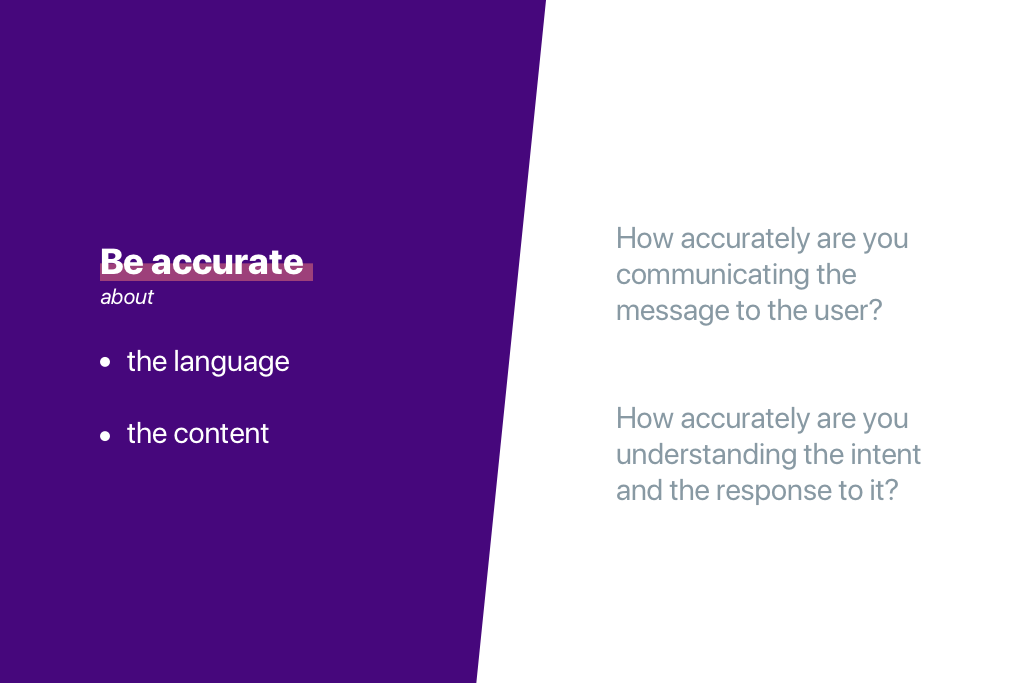
Conversational designers need to know the ins and outs of the language they write copy in. That means understanding all the nuances of the language and how it may differ across regions, e.g. “Hello! How are you?” and “Hey! How’s it going?” are similar in meaning, but the latter has a more Australian phrasing. The same goes for “No problem.” and “No worries.“
Besides making sure that whatever response we’re creating is in plain English that the user can easily understand, we also need to check our understanding of the material we’re using to craft our copy. If we don’t get what something means precisely, it will impact our ability to relay it to the user.
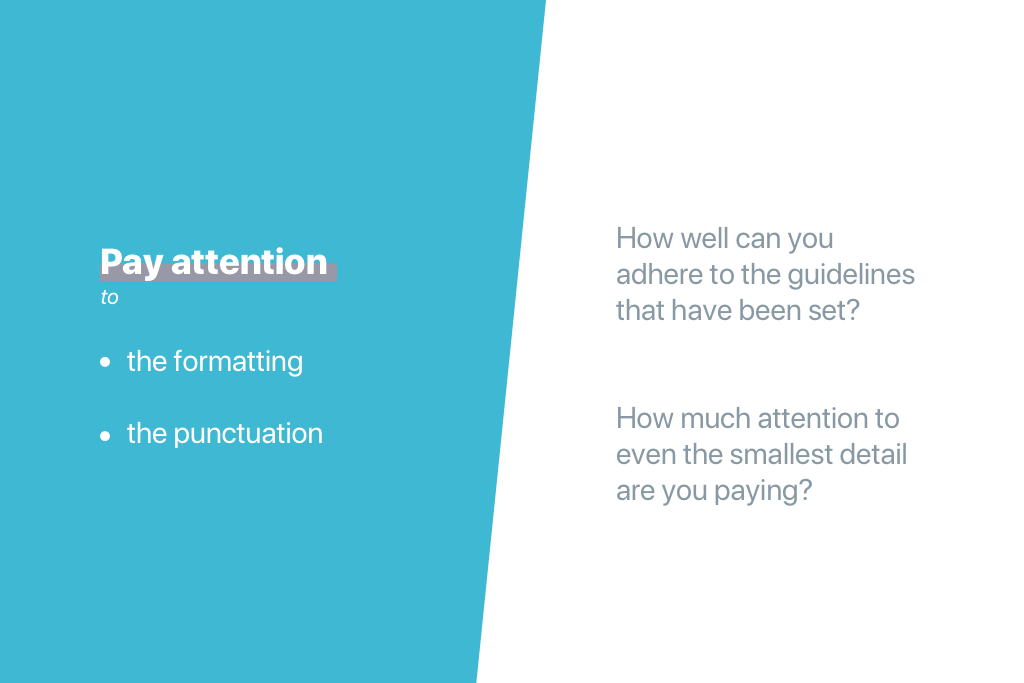
Conversational designers may already have style guides that they need to refer to and adapt to a chatbot setting. We need to carefully consider everything in the guidelines given to us and note down any concessions we need to make so that the copy reads better as a conversation with a chatbot. For example:
You can visit us between 9am-5pm on Mondays to Fridays, 9am-3pm on Saturdays or 9am-12pm on Sundays. We’re closed on public holidays.
You can visit us between:
– 9am-5pm on Mondays to Fridays
– 9am-3pm on Saturdays
– 9am-12pm on Sundays
We’re closed on public holidays.
By breaking the sentence into a list, we can make it easier for the user to scan for the information they need.
We can also look at how users may generally approach instructions and make sure the copy is easy to follow. For example:
1. Go to Me.
2. Select Mobile number under My contact details.
1. Go to Me.
2. Find My contact details and select Mobile number.
By arranging the steps logically so that we tell the user what to look for in chronological order, we can help the user follow the steps better, especially when faced with a longer set of instructions.
It may not seem like much, or it might appear quite obvious. But it’s these smaller details that can create a smoother experience for our users!
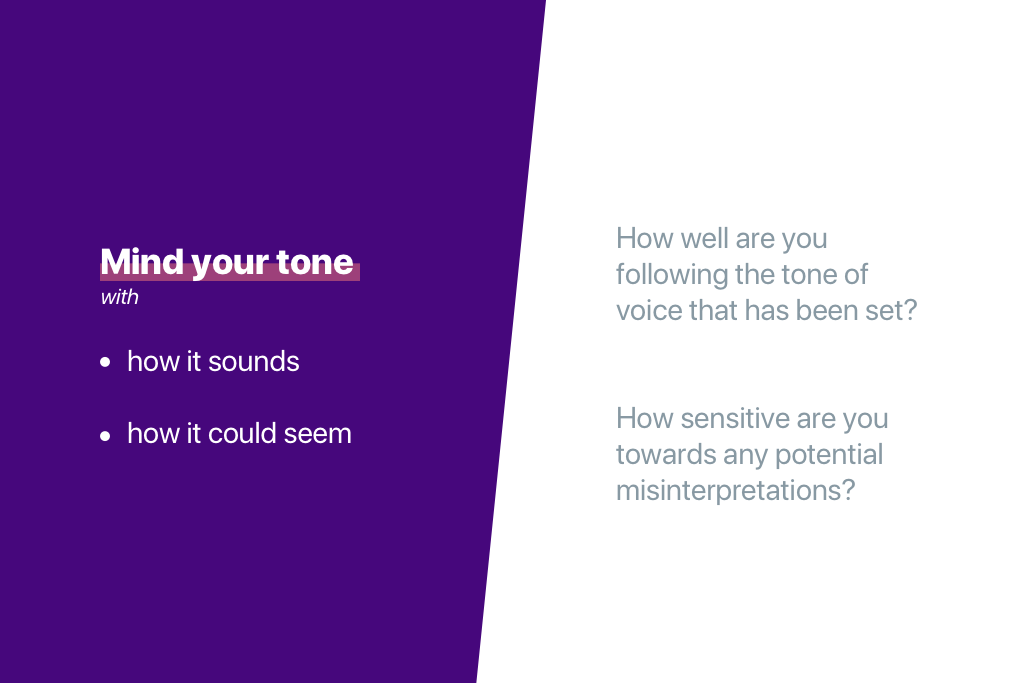
Conversational designers must have a keen sensitivity towards tone. We’ve all heard horror stories about how a simple misunderstanding arose over a text because someone misinterpreted it. Just think back to the last time you asked “Hey! How are you?“, and someone wrote back “Fine“.
Without body language or tonal inflexions to convey the right emotion, we might interpret that “Fine” as neutral at best, or passive-aggressive at worst. Consider:
We’ll deal with it within 4 working days.
We’ll sort it out within 4 working days.
It’s all the more critical that we are very aware of how the copy might sound to a frustrated user. As I often tell my team of conversational designers, “when in doubt, read it in an angry voice!”
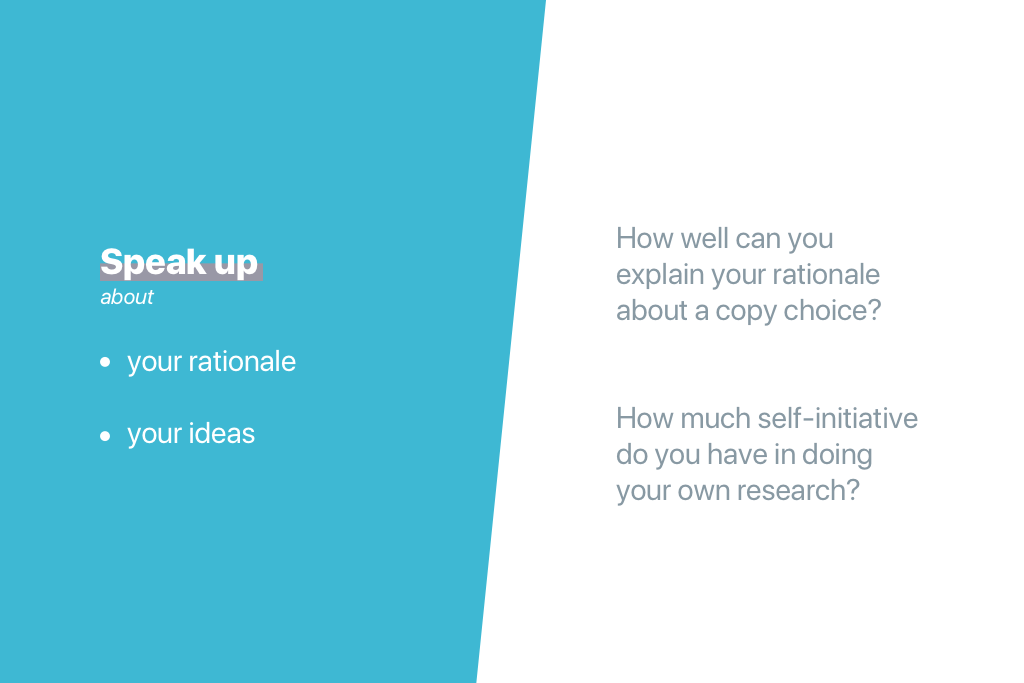
Conversational designers should also learn to explain the reasons behind a copy choice. Is it due to grammar, technical limitations, tone or results from testing that we’ve gone with a particular wording? We often work with different stakeholders who might question us, so we need to be ready to clarify any concerns raised. At the same time, we should remain open to critique.
We must also have the initiative to research other chatbots on the market, what we can learn from them, and how to incorporate these insights into our own best practices.
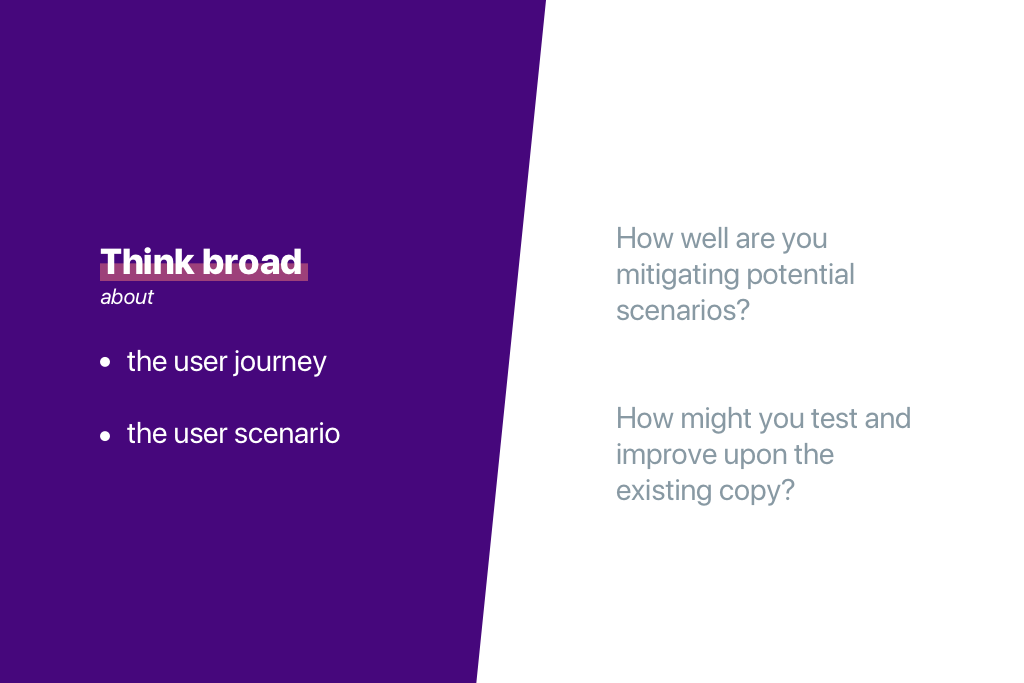
Conversation designers will also need to be able to imagine different scenarios in which the user may interact with the chatbot. As an example:
To update your mobile number, please log on and follow these steps.
1. Go to Me.
2. Find My contact details and select Mobile number.
- Repeat the user’s intent, so the user knows if the chatbot has misunderstood the query
- Mitigate for if the user has already logged on or if they haven’t done so yet
- Use verbs that can be applied across different devices if the product is not exclusively a mobile or desktop one.
But because no conversation designer is perfect, there may be things that we’ve overlooked in previous iterations of our copy. Therefore, We need to have the ability to conduct retrospectives and see how we can test and improve it further.
How can I improve my own skills in this area?
Testing out different chatbots on a variety of platforms is not enough. We should also actively evaluate what we liked or disliked about the experience. What made us smile? Did we feel confused by the response? How could we avoid that? How could we do better? Then, examine how that could apply to your chatbot.
I would also recommend playing interactive story games. They help to hone sensitivity towards turn-based interactions, so you’ll gain a better sense of how you can break lengthier responses into more bubbles as well as how many bubbles the chatbot could send before the user might start to feel annoyed.
What’s the future of conversation design?
There’s no telling how quickly chatbots will evolve so that even commercial chatbots would be more on par with Siri, Alexa and Google Assistant. But the future of voice user interfaces looks bright, and with it, conversation design.
As such interfaces become increasingly integrated with our lifestyles, it’s reasonable to anticipate that users will expect to be able to do more through chatbots, whether they’re communicating with it through texting or speaking. Tech companies must, therefore, consider what the next phase of their offerings should look like to accommodate these expectations.
And I would strongly encourage any copywriter to look into conversation design.
 Winnie Choi